Freezes the pack mid-flight
A 40 µs strobe at 0.75 m/s limits motion blur to about 0.03 mm. A red band-pass filter keeps room light out of the image.
Example engagement
A representative snack line where nitrogen-flushed pouches go stale because nobody can check seals fast enough, and how a Lensnode V, low-angle red light and a Gatepoint G2 would close the gap.
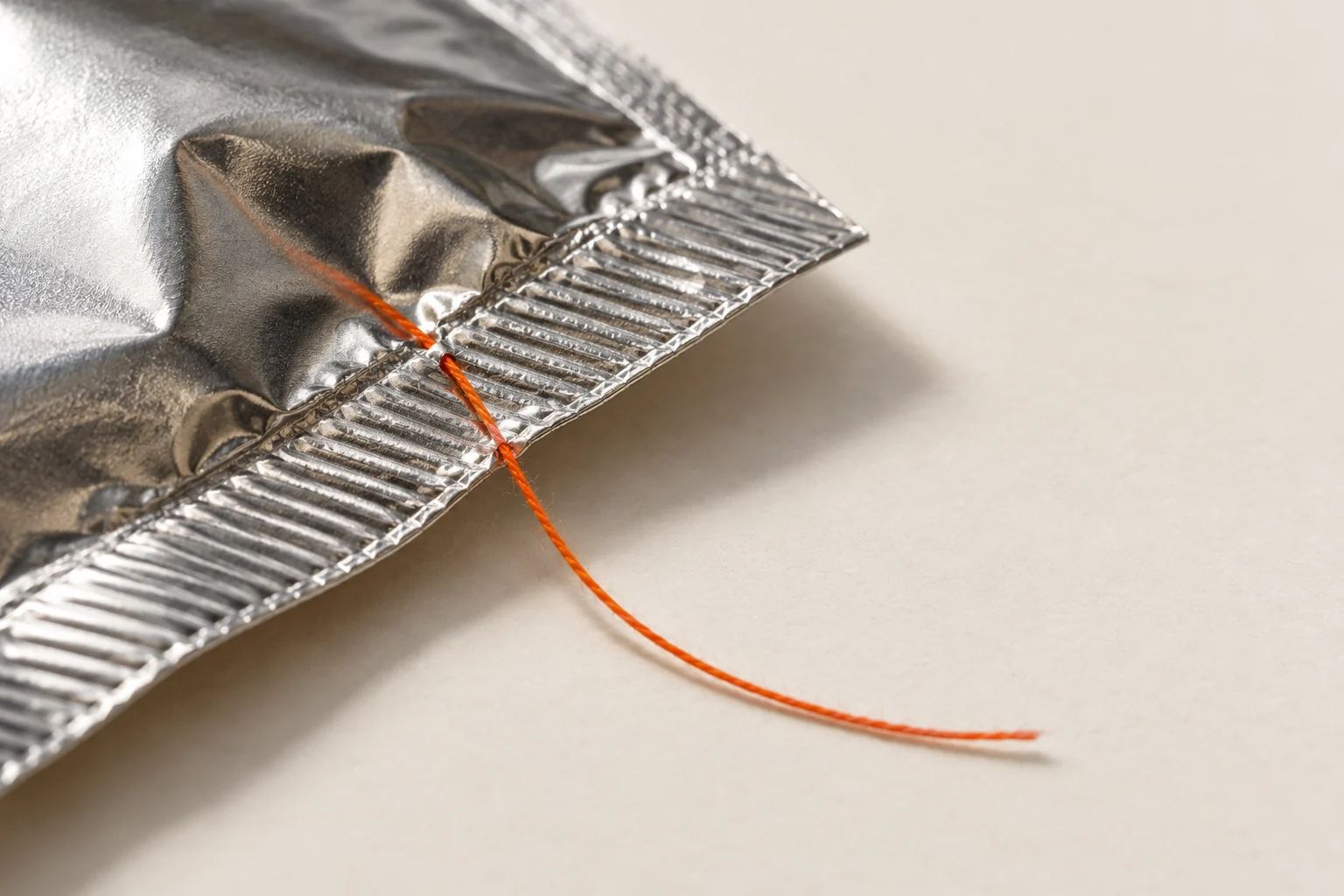
Example engagement — a representative scenario built from typical deployment parameters. Figures are modeled, not reported results from a named client.
Modeled results
fewer leaking-seal escapes (modeled)
false-reject rate on good packs (modeled)
of packs imaged at both end seals
The situation
Picture a snack plant packing single-serve bags of kettle chips on a high-speed vertical form-fill-seal bagger. Each pouch gets a fin seal down the back, a crimped jaw seal at each end and a nitrogen flush to keep oxygen away from the oil in the chips. The bagger runs at 180 packs per minute, three shifts a day.
A leaking seal doesn't show up at the plant. It shows up weeks later as a stale bag in someone's pantry, then as a complaint nobody can trace to a shift. The causes are familiar to anyone who has run a bagger: a chip fragment or a pinch of seasoning caught in the jaws, a pleat folded into the seal when the film tracks off center, or jaws running a few degrees cold after a changeover.
The plant's defense is an hourly vacuum-chamber leak test: a few packs submerged and watched for bubbles. It is a good test of the packs it checks. But a jaw problem that starts at 2:10 a.m. runs until the 3:00 a.m. pull, and 50 minutes at 180 packs per minute is about 9,000 packs.
Constraints
Approach
The plant sends about 200 good packs and 60 leakers, each marked with its known cause. In our optics lab, low-angle red light wins: on metallized film the flat areas mirror the light away from the lens and go dark, while crimp ridges, pleats and trapped crumbs scatter it back. The printed graphics almost vanish. The go/no-go report finds a visible cause on about 9 in 10 sample leakers.
A loaner Lensnode V and Gatepoint G2 judge every pack in shadow mode while flagged and passed packs go to the vacuum test. Success criteria, agreed in writing up front: catch at least 85% of the leakers the test finds, with false rejects under 0.5%.
A stainless bracket and light shroud, encoder tracking and an air-blast reject with a confirm sensor; the bagger stops if a reject fails to confirm twice in a row. Factory acceptance runs on the plant's own film, then site acceptance against the Proof of Value baseline.
Perflens Care Essentials tracks confidence and reject rates by SKU, retrains twice a year and flags drift when a new film lot changes how the crimp reflects light.
What the system does
A 40 µs strobe at 0.75 m/s limits motion blur to about 0.03 mm. A red band-pass filter keeps room light out of the image.
Two triggered exposures per pack, leading and trailing seal, using region-of-interest readout so the camera never limits line speed.
Product in seal, pleats and faint crimp are classified separately; an anomaly score catches disruptions the model was never trained on.
Encoder tracking times the air blast, and the confirm sensor checks every flagged pack left the belt. See reject integration.
When product-in-seal events climb above the shift baseline, the stack light and a Console alert point to the jaws rather than the film.
Perflens Console stores each reject with its SKU, cause and model version, so quality can answer a complaint with evidence.
Modeled results
fewer leaking-seal escapes reaching customers
of good packs falsely rejected
from a jaw fault to an operator alert, against up to an hour between pulls
of packs imaged, instead of a few per hour
Modeled for one bagger at 180 packs per minute, three shifts, five days a week, with leak rates and causes typical of vacuum-test logs on this kind of line. Assumes about 9 in 10 leaking seals have a visible cause in the end-seal area; film pinholes and fin-seal leaks are invisible to this station. The false-reject figure assumes stable film supply; a new supplier is treated as a retraining event.
Phase two
Related services
Turnkey cells with the optics, lighting, edge compute and reject integration this station relies on.
Read more
Drift monitoring and scheduled retraining that keep a seal model accurate through film lots and SKU changes.
Read more
Inspection and monitoring designed around sanitation, foreign-material rules and fast packaging.
Read moreFAQ
Usually not directly; a channel through a crimp seal can be a fraction of a millimeter wide and hidden inside the fold. A camera reliably sees the cause, such as a crumb in the seal, a pleat or a faint crimp. That is why the vacuum test stays as an audit, and why the modeled result is about 90%, not 100%.
Inspection-as-a-Service starts from $2,950 per station per month on a 36-month term, including hardware, Console, Care Essentials and hardware replacement. As a capital purchase, single-station systems typically run $48,000–$140,000 installed. See pricing.
Send a box of good packs and a bag of leakers. A three-week Feasibility Sprint shows which leak causes a camera can see on your film, and what catching them is worth.