Particulate and container inspection
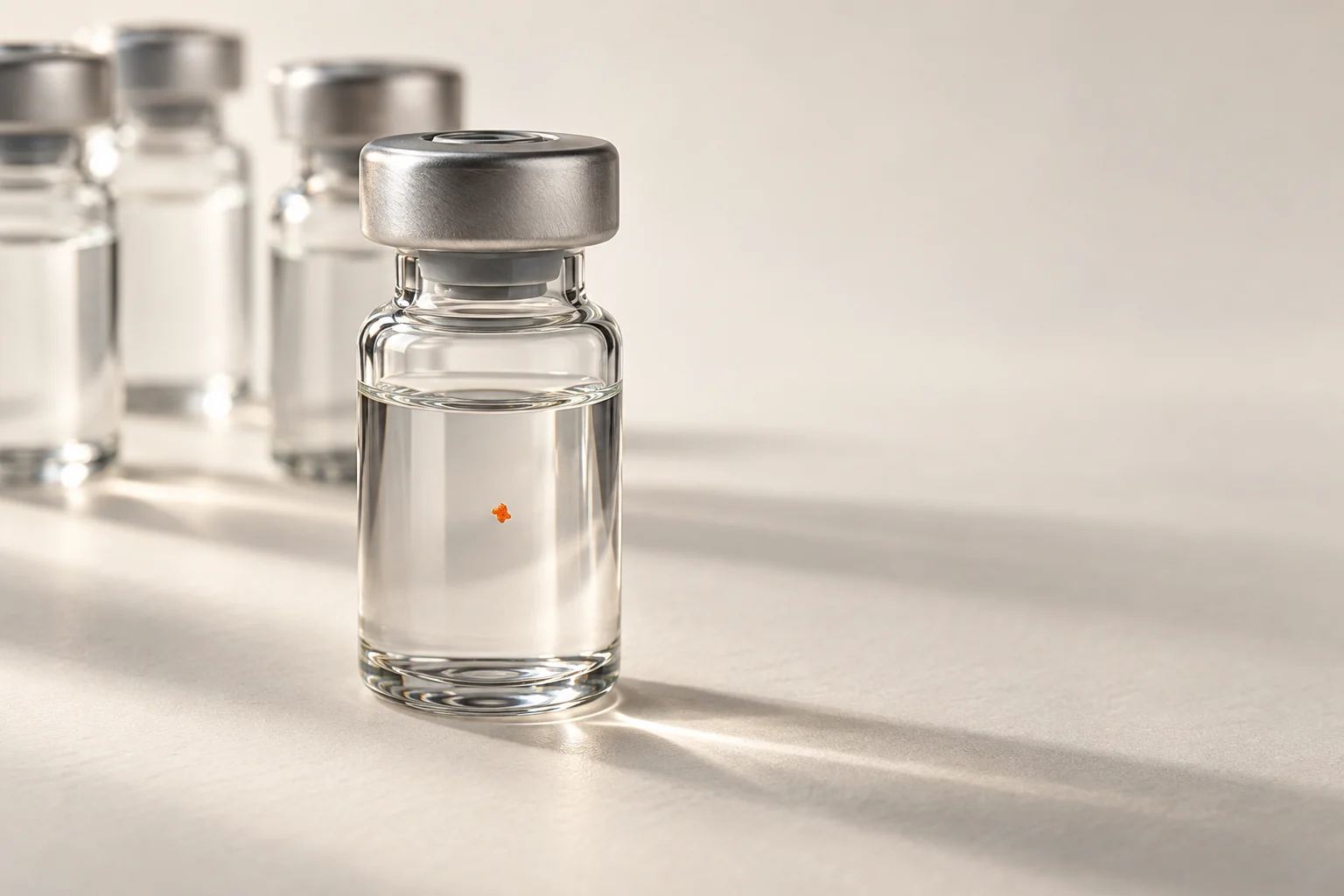
Visible particles, cracks, chips and cosmetic container defects in vials and syringes. Learned models are better than fixed rules at telling bubbles from particles, which is where false rejects come from.
Pharma & medical devices
We build AI inspection for containers, blisters, labels and device assemblies, with locked models, full audit trails and documentation designed to support your validation program from the first protocol.
What goes wrong
Regulated manufacturers carry two inspection problems at once. The first is the defect itself: a visible particle in a vial, a cracked syringe barrel, an empty blister pocket, a missing O-ring in an autoinjector, or a label carrying the wrong lot or expiry. Any of these can reach a patient, and several can trigger a recall.
The second is the cost of changing anything. Manual inspection booths depend on qualified inspectors whose attention fades over a shift, and whose judgement varies from person to person. Rule-based automated inspection struggles to tell an air bubble from a particle, so it rejects good product to stay safe. Improving either one means requalification, so many lines live with a known weakness for years.
AI inspection can reduce both problems, but only if it is built the way your quality system needs: models that are locked and versioned, decisions that are recorded and attributable, and documentation that your validation team can work from rather than rewrite.
Applications
Visible particles, cracks, chips and cosmetic container defects in vials and syringes. Learned models are better than fixed rules at telling bubbles from particles, which is where false rejects come from.
Empty pockets, broken or chipped tablets, wrong-color or foreign tablets, and lidding seal defects, checked on every blister at machine speed.
Lot, expiry and product identifier read from human-readable text and 2D codes, then matched to the batch record your MES or line controller provides.
Component presence, orientation and seating on autoinjectors, inhalers, catheters and kits, with an image saved for every assembly the system judges.
When real defect samples are scarce, synthetic defect data broadens training. Qualification still uses real, characterized defect sets.
Perflens Console stores every decision with its image and model version. A private copilot can draft batch inspection summaries for a person to review; it never makes the pass/fail call.
Recommended stack
| Application | Hardware | Service |
|---|---|---|
| Particulate and container inspection | Multiple Lensnode V with backlight and strobe; Gatepoint G4 or G8 | AI Visual Inspection |
| Blister and packaging | Lensnode V; Lensnode M where tablets differ by composition, not color; Gatepoint G2 | AI Visual Inspection |
| Label and serialization | Your existing cameras or Lensnode V; Gatepoint G2 | Vision Retrofit |
| Device assembly | Lensnode V at each assembly station; Gatepoint G4 | AI Visual Inspection |
| Rare-defect training data | Generated images, validated against real samples | Synthetic Defect Data & Model Training |
| Batch inspection summaries | Gatepoint G8, on-premise | Private Vision-Language Copilot |
Validation and compliance
We don't claim compliance on your behalf; that depends on how your organization validates and operates the system. What we do is build and document the system so your validation work has what it needs.
Honest fit
Services
Optics, lighting, edge compute and reject integration for containers, blisters, labels and assemblies, with an image for every decision.
Read more
Dataset engineering, generated rare-defect images validated against real samples, and a model card for every model.
Read moreFAQ
No system is compliant on its own; compliance depends on how it is validated and operated. Perflens systems are designed to support your 21 CFR Part 11 and GMP validation programs, with audit logging, role-based access, single sign-on and recorded model versions. Your quality unit makes the compliance determination.
The validated model stays locked. Retraining produces a candidate model, which runs in shadow mode against your challenge sets and is deployed only after approval through your change control. Every result records which model version made it.
We recommend using them for training, not qualification. Generated images help a model learn rare defects, but challenge sets used to demonstrate performance should be real, characterized defect samples. Our article on when synthetic data helps explains why.
Yes. Lensnode cameras are available in an IP69K housing in 316L stainless steel that tolerates wipe-down and cleaning agents, and we provide a materials list for your review. Our field engineers follow your gowning and entry procedures during installation.
With a Feasibility Sprint: you send good units and your defect library, and in three weeks we report, in writing, what can be detected and at what false-reject rate. That report also helps shape your user requirements.
Send us characterized defect samples and good units. A three-week Feasibility Sprint shows what AI inspection can detect before anyone writes a protocol.