Services
Platform
Industries
EngagementsPricing
Resources
Company
Book a discovery call (470) 784-4045

Edge Stack hardware

Cameras, sensors and gateways built for the plant floor

Lensnode sees, Pulsenode listens and Gatepoint decides. Three product families share one mounting, connector, security and update model, and are designed for heat, dust, vibration and washdown.

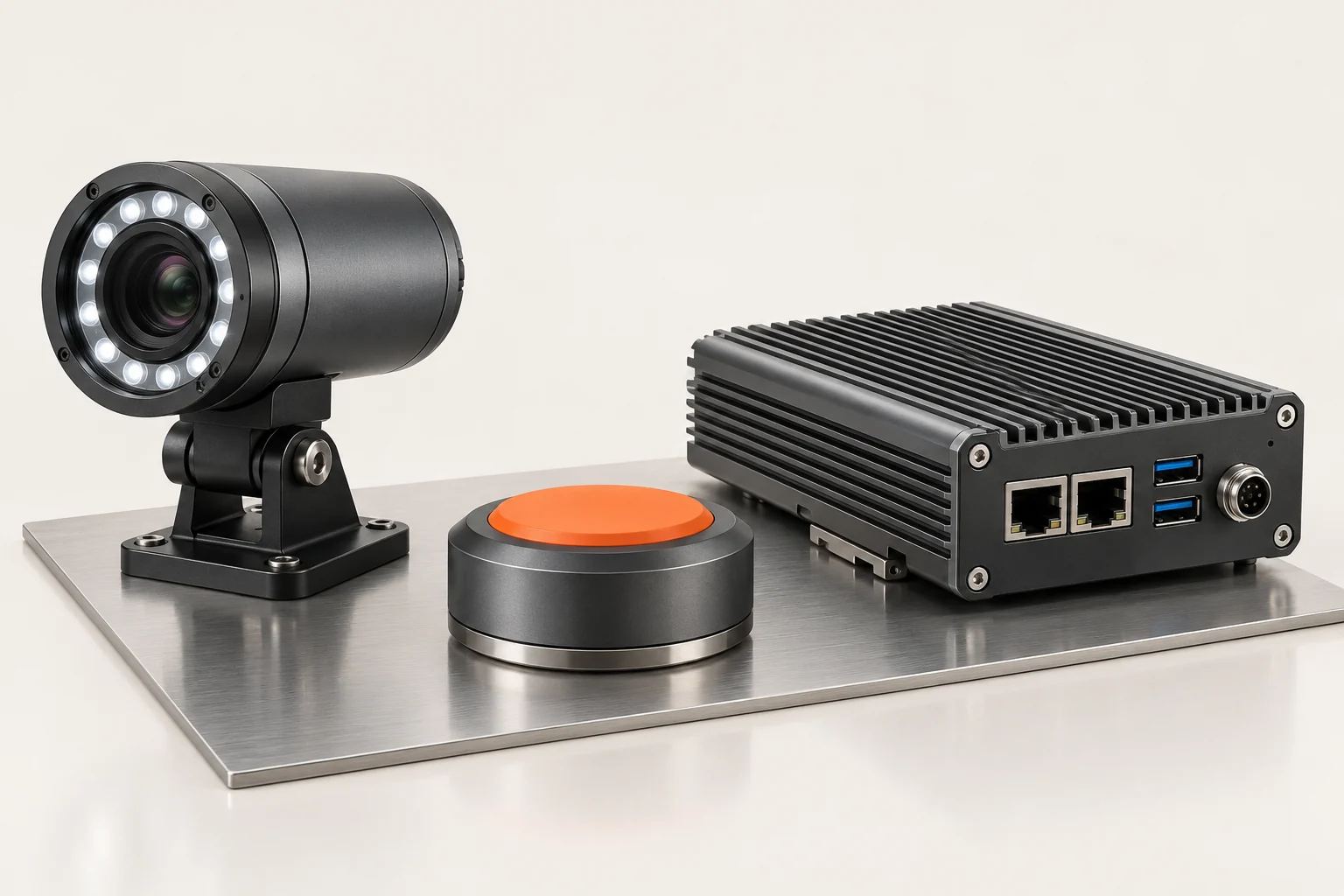
The Perflens hardware family — a ring-lit smart camera, a puck-shaped vibration sensor and a finned edge gateway — on a steel plate.
FIG. 21The Perflens hardware family together on one steel plate.

Why our own hardware

Industrial smart cameras and sensors that share one design

Most edge projects are assembled from parts that were never meant to meet: a machine-vision camera from one catalog, an industrial PC from another, a wireless vibration sensor that reports to someone else's cloud. Each has its own firmware, its own update tool and its own idea of security, and the integration work never really ends.

We design Lensnode, Pulsenode and Gatepoint as one family. They share connectors and mounting conventions, enroll into the same Perflens Console, receive signed updates through the same channel and are covered by the same Perflens Care tier. When a project needs something the catalog doesn't cover, our smart optical sensor team designs it.

We are not dogmatic about it. If your line already has capable cameras, Vision Retrofit runs our models on a Gatepoint behind them.

Product family

Lensnode, Pulsenode and Gatepoint

Variants are chosen by the physics of the problem. Your Feasibility Sprint or site survey tells us which ones you need.

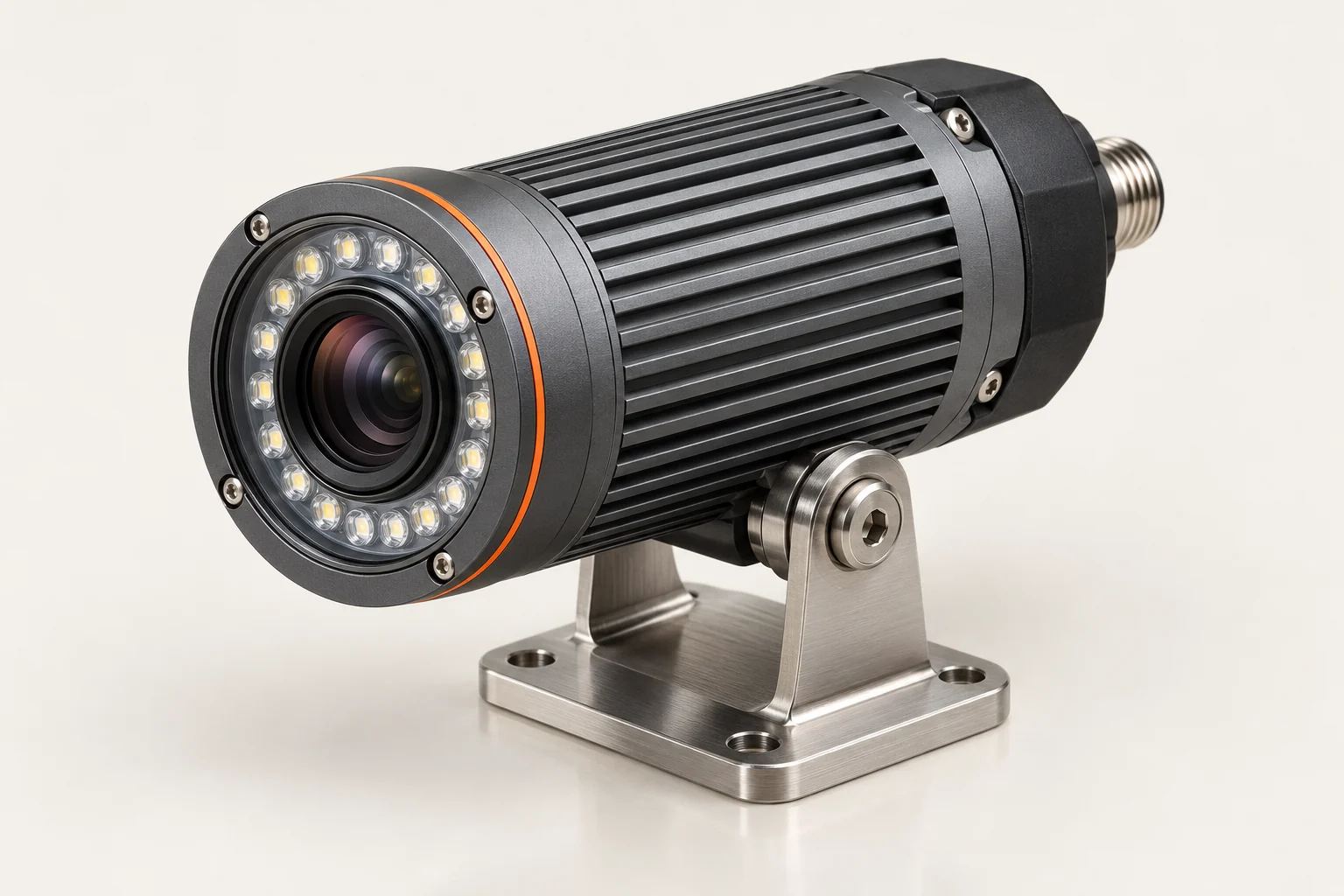
Lensnode, a compact cylindrical smart camera with a ring light and an orange status ring, on a stainless bracket.

Lensnode

Smart optical sensor

A camera with its own illumination and on-board pre-processing, sealed in a housing that survives the line. Lensnode V sees surface and assembly defects, Lensnode T reads temperature at every pixel, and Lensnode M separates materials that look identical to the eye.

Lensnode V
5 MP global shutter; interchangeable C-mount optics; integrated programmable strobe ring (white, red, IR 850 nm); up to 120 fps at full resolution, faster in ROI modes
Lensnode T
640 × 512 radiometric thermal, LWIR 8–14 µm; ±2 °C or ±2% accuracy; 30 Hz
Lensnode M
8-band multispectral, visible to 1,000 nm, for sorting and foreign-material detection
Power and data
PoE+ over one M12 X-coded Ethernet cable
Housing
IP67 aluminum; optional IP69K 316L stainless washdown housing
Operating temperature
−20 to 55 °C
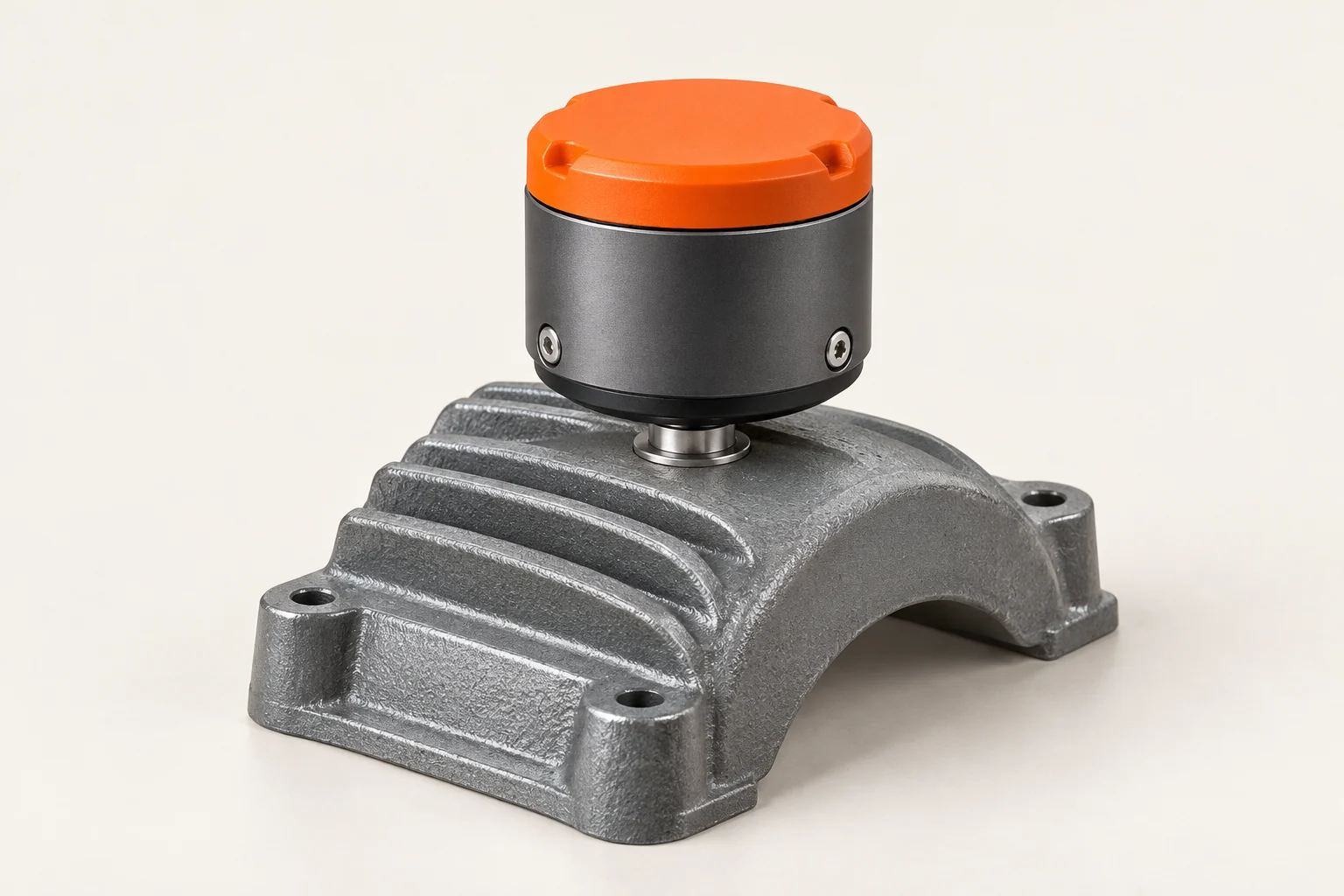
Pulsenode, a puck-shaped wireless vibration sensor with an orange cap, mounted on a motor housing.

Pulsenode

Condition-monitoring node

Sensors for the machines and utilities behind the line. Pulsenode W bolts onto rotating equipment and runs for years on its battery; Pulsenode C clamps into panels and motor control centers; Pulsenode U listens for leaks and lubrication faults in the ultrasonic band.

Pulsenode W
Wireless and battery-powered; tri-axial MEMS vibration 2 Hz–10 kHz, surface temperature, and magnetic flux for motor speed and load signature
Pulsenode W battery
Up to 5 years at hourly sampling
Pulsenode W rating
IP68; Class I Division 2 variant available
Pulsenode C
Clamp-on electrical node for panels and motor control centers; current and voltage harmonics, phase imbalance, energy
Pulsenode U
Ultrasound 20–100 kHz for compressed-air leaks, steam traps and early bearing lubrication faults
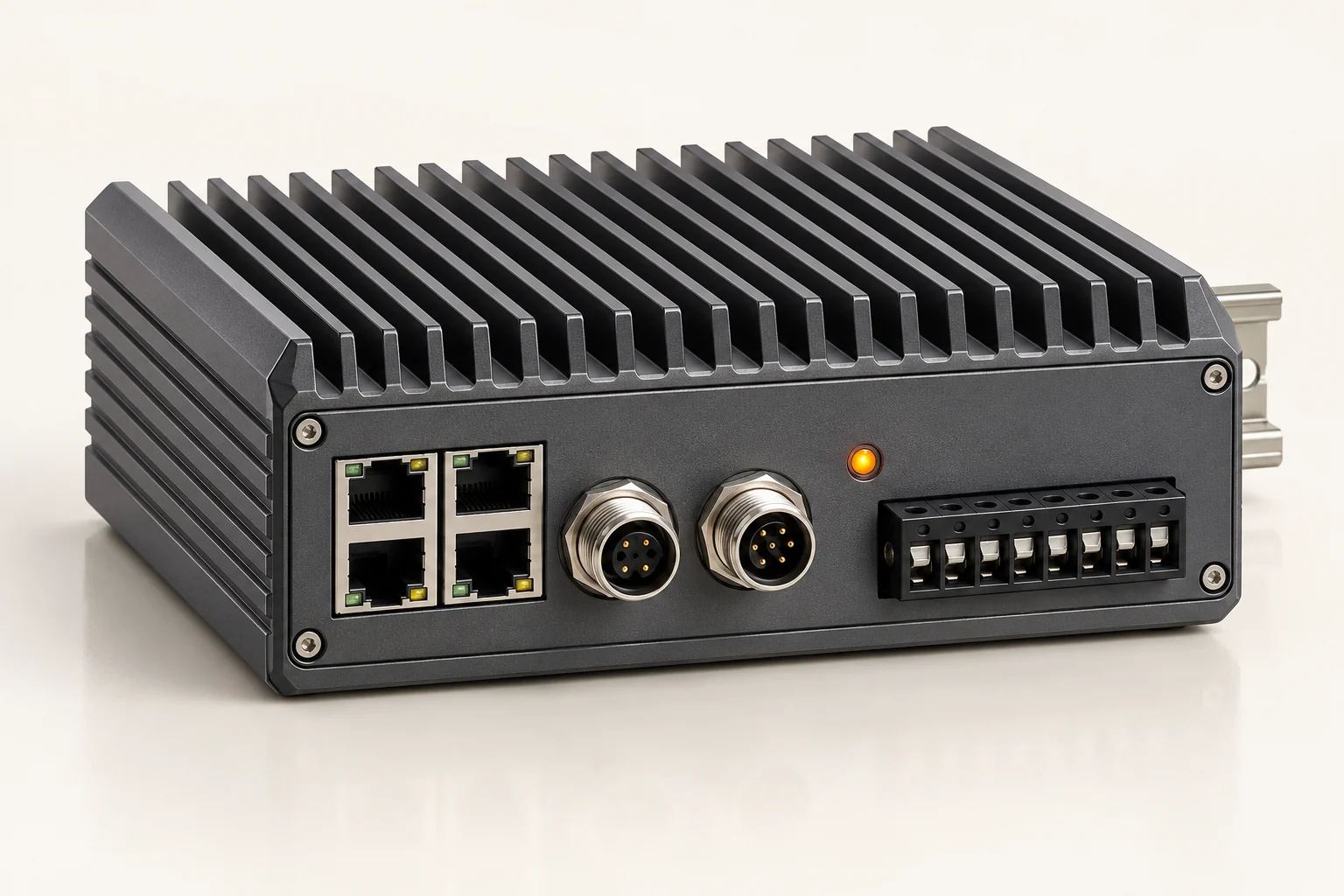
Gatepoint, a fanless finned edge computer with network ports, terminal contacts and an orange status light.

Gatepoint

Edge AI gateway

The decision layer. Gatepoint runs inspection and condition models beside the asset, drives reject gates and stack lights directly, and hosts Perflens Console for a cell or small area. Four variants cover everything from a single camera to a multi-camera line running the vision-language copilot.

Gatepoint G2
Hailo-8-class accelerator; fanless; up to 4 camera streams; 15 W typical
Gatepoint G4
NVIDIA Jetson Orin-class; fanless; up to 12 camera streams
Gatepoint G8
NVIDIA Jetson Thor-class; for multi-camera lines and the on-device vision-language copilot
Gatepoint XT
Qualcomm Dragonwing-class; −40 to 70 °C for outdoor, substation and cold-storage sites
Interfaces
2× 2.5 GbE; 4× PoE+ on G4 and G8; isolated digital I/O for reject gates and stack lights; RS-485
Security
TPM 2.0; secure boot; signed A/B over-the-air updates
Power and mounting
24 V DC input; DIN-rail or wall mount
Decision latency
Under 40 ms frame-to-I/O for typical inspection models

Ratings

Environmental ratings at a glance

Pulsenode C and U ratings depend on the mounting option and are listed per location in your proposal, together with any enclosure we supply.
ProductTypical locationHousing and ingressOperating temperaturePower
Lensnode V, T, MAt the point of inspection, including washdown zonesIP67 aluminum; IP69K 316L stainless option−20 to 55 °CPoE+ from a Gatepoint or PoE+ switch
Pulsenode WMotors, bearings, gearboxes, fans and pumpsIP68; Class I Division 2 variant for hazardous locationsChecked against each asset's surface temperature at surveyInternal battery, up to 5 years at hourly sampling
Gatepoint G2, G4, G8Control cabinet near the line, on DIN rail or wallCabinet-mounted; G2 and G4 fanlessIndoor industrial cabinet24 V DC
Gatepoint XTOutdoor enclosures, substations, cold storageSealed for outdoor and unheated enclosures−40 to 70 °C24 V DC

Installation

Mounting and installation

Our field engineers install everything we supply. These are the conventions we design around, so your maintenance team can live with the result.

Lensnode on the line

Rigid brackets referenced to the conveyor, guards and protective windows, and one M12 cable for power and data. If a knock or a cleaning crew moves the field of view, it shows up in image statistics the same day.

Pulsenode W on rotating equipment

Stud-mounted on a prepared flat or bonded to a mounting pad, as close to the bearing load zone as the machine allows. Placement is chosen by a vibration analyst, not by convenience.

Pulsenode C in the panel

Clamp-on current sensors fit around existing conductors without disconnecting them. Voltage connections are made by a qualified electrician under your lockout/tagout procedure.

Gatepoint in the cabinet

DIN-rail or wall mount on 24 V DC, in an existing control cabinet or an enclosure we supply. Isolated outputs wire directly to the reject gate and stack light.

On its own network zone

Devices sit in their own OT zone with documented ports. Nothing needs internet access, and remote support is an outbound connection you can switch off. See security.

Tested twice

Every inspection cell runs a factory acceptance test in our lab before it ships and a site acceptance test on your line, with forced-fault checks of every failure state.

Lifecycle commitment

Seven years of supply, in writing

Plants run equipment for decades. Embedded compute modules have much shorter commercial lives, and a camera discontinued two years after installation turns a routine failure into a redesign.

So we put it in the contract: we will supply each model, or a drop-in compatible replacement, for at least 7 years from your first installation. Drop-in compatible means the same mounting, connectors, power and interfaces, so a replacement goes into the bracket, cable and cabinet you already have.

Where a replacement changes something the model depends on — a new image sensor in a Lensnode, or a new compute module in a Gatepoint — we recompile the model from its ONNX source for the new hardware and validate it against your original acceptance data before the unit ships. Your inspection results should not change because a part did.

Spares

Spares and replacement

Downtime spent waiting for a part is the most avoidable kind. Advance replacement means the new unit ships before the faulty one comes back.

  • A recommended spares list for every site, sized to the number of stations and your cost of downtime
  • Advance replacement in 3 business days on Care Essentials, and next business day on Care Verified and Care Dedicated
  • An on-site spares kit held at your plant on Care Dedicated
  • Hardware replacement included for the full term of Inspection-as-a-Service and monitoring subscriptions
  • Replacement Gatepoints restore configuration, models and certificates from Perflens Console when they enroll
  • Protective windows, lens covers and mounting pads stocked as consumables

FAQ

Questions we hear often

Can we use our own cameras instead of Lensnode?

Often, yes. Gatepoint can run models on many industrial cameras already installed on your line. We check the sensor, optics, lighting and interface during a Feasibility Sprint or retrofit survey, and tell you honestly if the existing camera is the limiting factor. See Vision Retrofit.

Which Gatepoint do we need?

G2 suits fixed models on up to 4 camera streams at 15 W typical. G4 handles up to 12 streams. G8 is for multi-camera lines and the on-device vision-language copilot. XT is for sites from −40 to 70 °C. We size with headroom for the retrained models that follow.

Can Pulsenode W go in a hazardous location?

A Class I Division 2 variant of Pulsenode W is available. Gateways and other equipment are placed outside the classified area or in an enclosure rated for it, specified per site in your proposal.

How does Pulsenode W communicate?

Over a low-power wireless link to a nearby gateway. Steel structures and motor control centers are hard on radio, so we survey coverage before installation and place gateways to suit.

Are full datasheets available?

Yes. Datasheets with electrical, mechanical and environmental detail for each variant are available on request through our contact page.

Match the sensor to the physics

Tell us what you need to see or hear. An engineer will tell you which Lensnode, Pulsenode or Gatepoint variant fits — or whether the cameras you already own will do.