Reads oily steel as steel
The model is trained on dry, freshly oiled and spatter-marked brackets, so glints and shadows stop passing for nuts or gaps.
Example engagement
One missing weld nut can mean a customer complaint and a containment sort. This representative stamping plant shows how Vision Retrofit and a PLC handshake would put six existing cameras back to work.
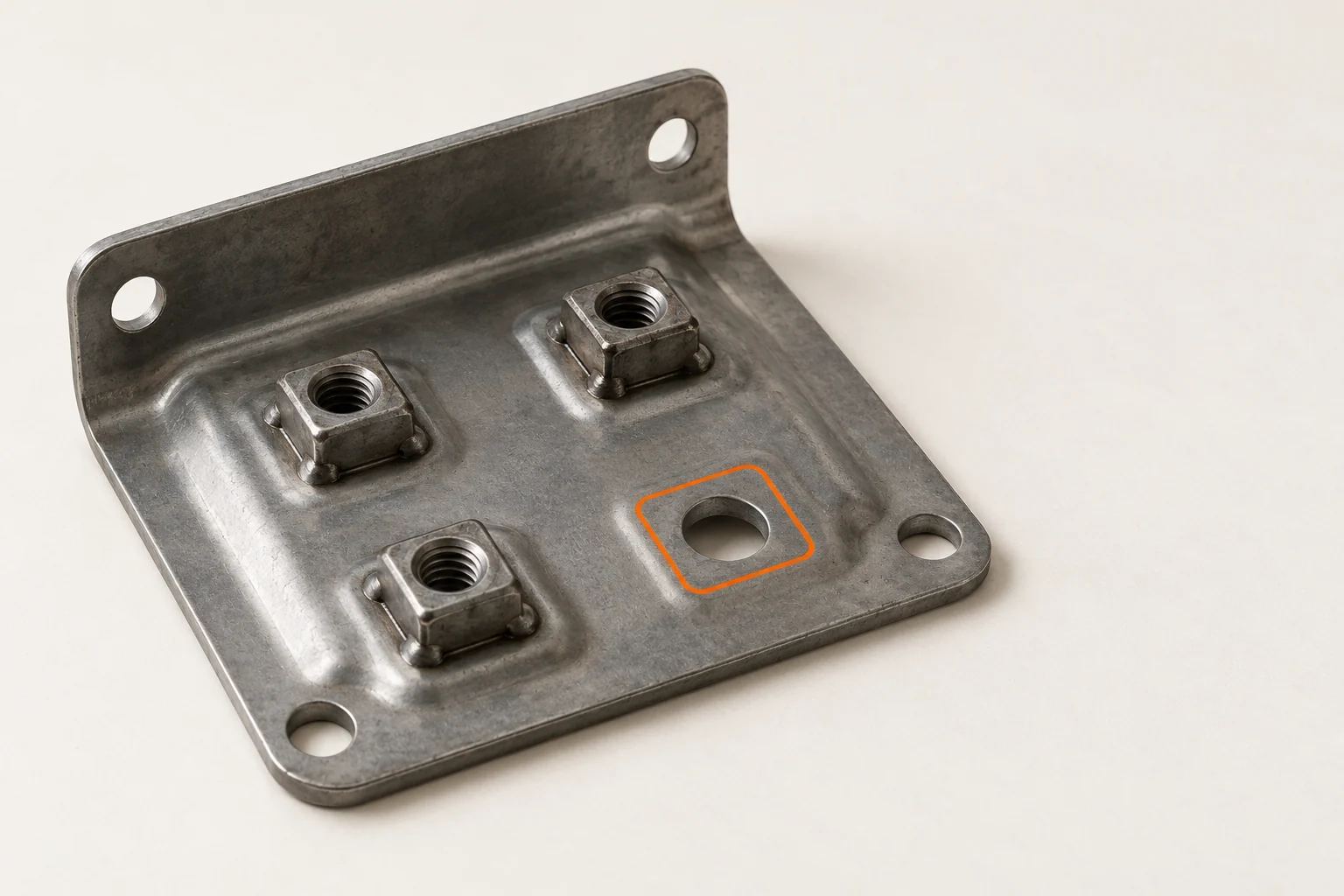
Example engagement — a representative scenario built from typical deployment parameters. Figures are modeled, not reported results from a named client.
Modeled results
missing-nut escapes to the customer in the modeled 12 months
less manual audit time (modeled)
existing cameras reused
The situation
Picture a Tier 2 stamping plant making seat and body brackets. Progressive dies stamp the parts; four projection-weld cells then attach two to four M8 weld nuts to each bracket, fed from vibratory bowls. An operator loads a bracket onto locating pins, the cell welds, and the part goes into a returnable container bound for an assembly plant.
Years ago the cell builder fitted six cameras running a rule-based presence tool. It worked on dry parts. Fresh stamping lubricant turned the steel into a field of glints that the tool read as nuts, while on other days the shadow beside a nut read as a gap. False rejects piled up, thresholds were loosened, and on two cells the check now sits in bypass.
What remains is the weld controller's electrode-travel check, which catches most no-nut welds but not a nut welded off its hole, and an hourly audit with a go/no-go thread gauge. One missing nut at the customer means a bracket that can't be bolted down and a containment sort of every container in the pipeline.
Constraints
Approach
The plant sends brackets with known faults (missing nuts, off-position nuts, spatter in threads, blank nuts from a mixed lot) plus images from its own cameras. In our lab we rebuild each cell's camera, lens and working distance and test the existing lights against two alternatives. Two ring lights have dimmed with age. The written verdict: go, with two new lights.
A loaner Gatepoint G4 takes the camera streams from two cells, including one that was in bypass, and runs in shadow mode beside the hourly audit. The team seeds known-bad red-rabbit brackets every shift. Success criteria, agreed in writing: every red rabbit caught, and fewer than 1 false reject per 1,000 parts.
All six cameras move to one Gatepoint G4. The plant's controls engineer adds the handshake to each cell PLC (part present, inspect, result, reason code, heartbeat) from our specification. A missing result holds the part in the fixture; a reject goes to a locked red bin with a part-present sensor. Control plan and PFMEA updates are signed off before go-live.
Perflens Care Essentials watches confidence by cell and nut size, retrains twice a year, and reports red-rabbit results in the monthly health report.
What the system does
The model is trained on dry, freshly oiled and spatter-marked brackets, so glints and shadows stop passing for nuts or gaps.
Each part number has a recipe listing its nut positions and sizes. The verdict is per position, so a bracket with three of four nuts cannot pass.
Under on-axis light, thread crests show as tight bright rings. A blank nut or a bore full of spatter looks different and is flagged. Thread class still belongs to the gauge.
An EtherNet/IP handshake with a heartbeat: if the gateway stops answering, the cell stops cycling rather than passing parts unchecked. See PLC integration.
Red-rabbit parts run at the start of each shift. A missed rabbit locks the cell until a supervisor signs off.
Perflens Console stores every verdict with its image, part number, cell and timestamp, so a customer query becomes a search instead of a sort.
Modeled results
missing-nut escapes to the customer
less operator and quality-technician time on manual audits
existing cameras reused, with two ring lights replaced
from frame to PLC result for each image
Modeled for four cells running three shifts, six days a week, at about 8 seconds per bracket. The escape figure assumes the heartbeat interlock is never bypassed and red-rabbit checks run every shift; it covers missing and off-position nuts, not thread class. Audit time compares hourly manual audits plus complaint-driven sorting with a reduced audit and image review of flagged parts.
Phase two
Related services
New models, lighting fixes and PLC integration for cameras a plant has already paid for.
Read more
Machine-state capture, microstop detection and loss trees by shift, from the same edge gateway.
Read more
Error-proofing and inspection for stamping, welding and assembly lines with demanding customers.
Read moreFAQ
Often not. If a camera has enough resolution for the feature and a stable mount, what usually fails is the lighting or the decision logic. In this scenario two ring lights were replaced and every camera, lens and bracket stayed.
No. It confirms that threads are present and the bore is clear of spatter. Whether a thread meets its class is a gauge question, so a sampled gauge check stays in the control plan.
Send images from your existing cameras and a box of known-bad parts. A Feasibility Sprint tells you in three weeks whether a retrofit will hold up, and what has to change.